

how to draw a line of best fit by hand
How do I construct a direct line through data points?
All-time-fit lines

Best-fit lines
tin can also be called:
Linear regression
Tendency lines
Questions that ask you to describe a best fit line or trend in the data usually practise not want you to "connect the dots". Instead, the question is asking you to think about how the two sets of data conduct in relation to one another. In general, nosotros fit lines to data when we want to utilize them for predictive purposes or to make up one's mind the general trend of the information.
About scientists use a computer plan to plot a best-fit line for a set of data merely constructing one for yourself is a good style to larn how it'southward done. Considering a computer isn't doing it, you may find that your "best-fit" line is slightly different from your lab partners. In most cases, that is okay, as long as you've mimicked the trend of the information.
Why (and when) should I use a all-time fit line?
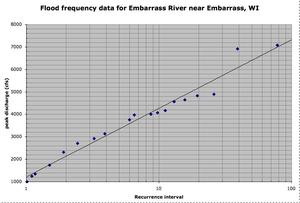
In introductory geoscience, most exercises that ask you to construct a best-fit line have to do with wanting to be able recognize relationships amongst variables on Earth or to predict the behavior of a system (in this instance the Earth organisation). We want to know if at that place is a relationship between the amount of nitrogen in the water and the intensity of an algal flower, or we wish to know the relationship of i chemical component of a rock to another. For predictive purposes, we might adopt to know how often an earthquake is likely to occur on a particular fault or the possibility of a very big flood on a given river. All of these applications use best-fit lines on scatter plots (x-y graphs with merely data points, no lines).
If you find yourself faced with a question that asks you to describe a trend line, linear regression or best-fit line, you are well-nigh certainly existence asked to draw a line through data points on a scatter plot. Y'all may also exist asked to approximate the trend, or sketch in a line that mimics the data. This page is designed to help you consummate any of these types of questions. Work through it and the sample bug if you lot are unsure of how to consummate questions about trends and all-time-fit lines.
How exercise I construct a best-fit line?
A all-time-fit line is meant to mimic the trend of the data. In many cases, the line may not pass through very many of the plotted points. Instead, the idea is to get a line that has equal numbers of points on either side. Well-nigh people start past eye-balling the data.
- Take a expect at the information and as yourself these questions
- Does the data expect like a line? or a large blob? Try to approximate the general trend of the data with your mind (even if it's but a hulk)

- Does the trend of the points expect positively
correlated (similar they rising upwardly to the right; click on paradigm at correct) or negatively correlated (like they beginning high near the 10-axis and get lower as they approach the y-axis; meet image to the left)? Your trendline (when you're finished with the side by side steps) should mimic those correlations.
- If you lot mistiness your eyes, can you see a thick line trending in 1 direction or another? This is some other way to visualize the trend of the data.
- Does the data expect like a line? or a large blob? Try to approximate the general trend of the data with your mind (even if it's but a hulk)
- Now that you lot have an idea of the full general trend of the information, there are two possible ways to construct a all-time-fit line by eye. You may use either of them; both are right and relatively easy ways to get a pretty accurate representation of a best-fit line. Choice the ane that makes the most sense to you. The first method involves enclosing the data in an area: The 2nd method involves dividing data into ii equal groups, approximating the centre of each group and amalgam a line between the two centers.
- Evaluate your best fit line. Think dorsum to the questions in number 1. Does your line look like you thought it should?
- Exercise yous see that there are approximately the same number of information points on each side of the line?
- And are they evenly distributed (that is, make sure that plots with a variety of ten values are on top (and bottom) of the line, not most in a higher place at the depression terminate and most below at the high stop)?
- Does your line minimize the average altitude from it to each of the data points?
Yous can also download and print a single sheet for constructing a best fit line with the area method (Acrobat (PDF) 33kB Sep10 08) or the dividing method (Acrobat (PDF) 34kB Sep10 08).
Where is this used in the geosciences?
There are many instances in the geosciences where scientists utilise a best fit line. In the introductory geosciences, we use them for:
- flood frequency curves
- earthquake forecasting
- Meteorite bear upon prediction
- convulsion frequency vs. magnitude
- climate change
Side by side steps - Some practice problems
If yous would like to know more about best-fit lines, you tin can employ the links beneath to read more about them
References and resource
- Honolulu Community College has a description of the surface area method and a page on graphs as a part of a Physical Science grade.
- Loyola University's Centre for Science Education has a discussion of the dividing method in this http://world wide web.luc.edu/cse/programs/sepup/IEY/data-analysis.ppt.

Source: https://serc.carleton.edu/mathyouneed/graphing/bestfit.html
Posted by: simmonsrons1966.blogspot.com
0 Response to "how to draw a line of best fit by hand"
Post a Comment