

Which Drawing In The Figure Is A Tetrad
2.i: Sizes, Shapes, and Arrangements of Bacteria
- Page ID
- 3107

Learning Objectives
- List the three basic shapes of leaner.
- List and describe 5 different arrangements of cocci.
- Define and give the abbreviation for the metric unit of measurement of length termed micrometer and state the average size of a coccus-shaped bacterium and a rod-shaped bacterium.
- List and describe 2 unlike arrangements of bacilli.
- Listing and describe 3 different screw forms of bacteria.
Bacteria are prokaryotic, single-celled, microscopic organisms (Exceptions have been discovered that tin reach sizes simply visible to the naked eye. They include Epulopiscium fishelsoni, a bacillus-shaped bacterium that is typically fourscore micrometers (µm) in diameter and 200-600 µm long, and Thiomargarita namibiensis, a spherical bacterium betwixt 100 and 750 µm in diameter. )
- generally much smaller than eukaryotic cells.
- very complex despite their pocket-sized size. Fifty-fifty though bacteria are unmarried-celled organisms, they are able to communicate with one another through a process chosen quorum sensing. In this way they tin can function equally a multicellular population rather than every bit individual leaner. This volition be discussed in greater item in Unit 2.
To view a nice interactive illustration comparing size of cells and microbes, see the Cell Size and Scale Resources at the Academy of Utah.
Bacterial cell shape is determined primarily by a protein called MreB . MreB forms a screw band – a simple cytoskeleton – around the interior of the cell just nether the cytoplasmic membrane. It is thought to define shape by recruiting boosted proteins that then direct the specific pattern of bacterial cell growth. For example, bacillus-shaped bacteria that have an inactivated MreB gene become coccoid shaped, and coccus-shaped bacteria naturally lack the MreB gene. Most leaner come up in ane of three basic shapes: coccus, rod or bacillus, and spiral.
Coccus
The cocci are spherical or oval leaner having i of several distinct arrangements (Figure \(\PageIndex{2}\).1.1) based on their planes of division.
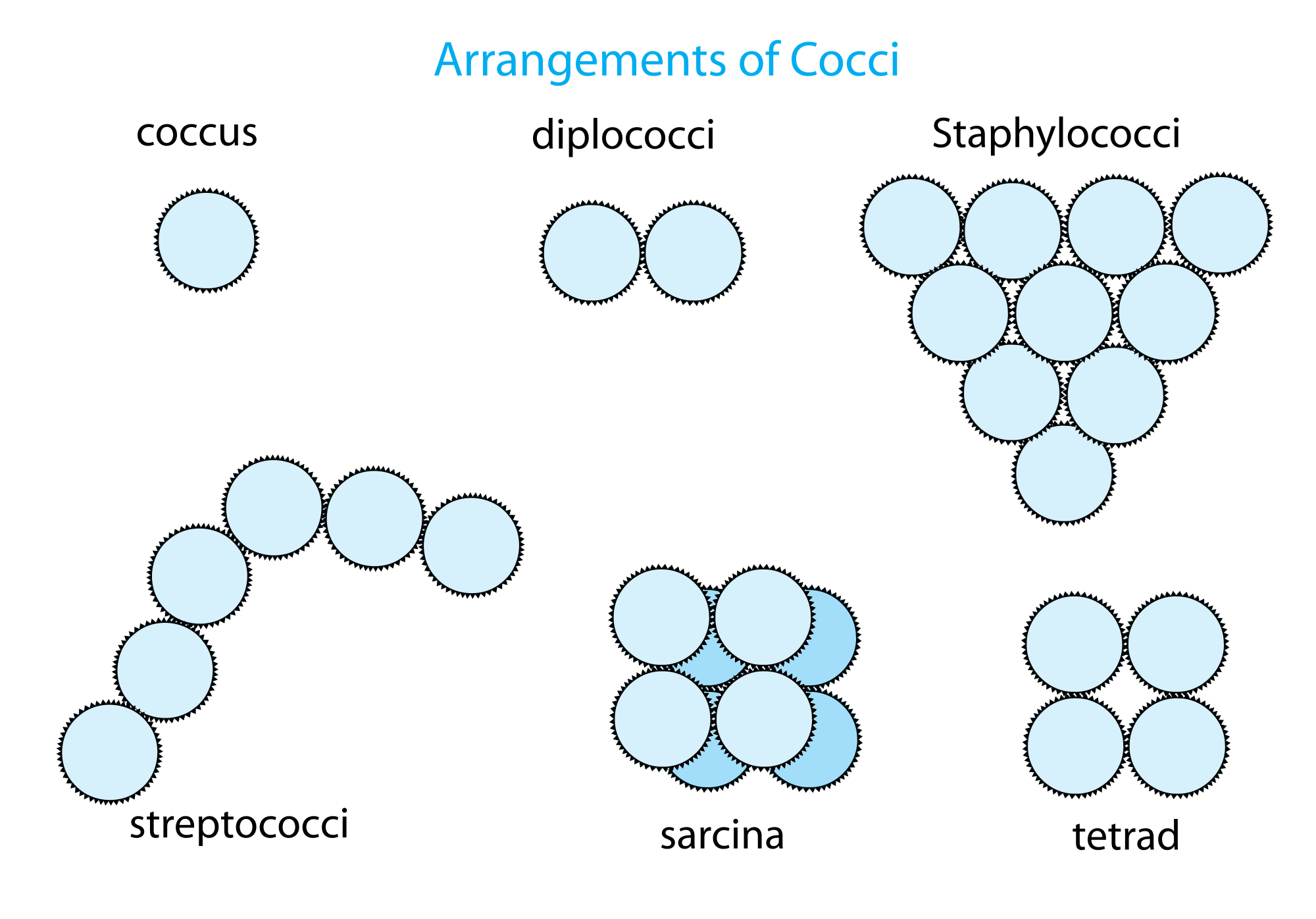
Figure \(\PageIndex{2}\).1.ane: Arrangement of cocci bacteria. image used with permission from Mariana Ruiz.
a. Partition in one plane produces either a diplococcus or streptococcus arrangement.
diplococcus: cocci bundled in pairs (run across Figure \(\PageIndex{2}\)) - scanning electron micrograph of a Streptococcus pneumoniae, a diplococcus; courtesy of CDC
- scanning electron micrograph of a Neisseria, a diplococcus; courtesy of Dennis Kunkel's Microscopy
streptococcus: cocci arranged in bondage (run across Figure \(\PageIndex{3}\)) - scanning electron micrograph of a Streptococcus pyogenes, a streptococcus; courtesy of Dennis Kunkel'due south Microscopy
- transmission electron micrograph of Streptococcus from the Rockefeller University web page.
- scanning Electron Micrograph of Enterococcus
b. Division in two planes produces a tetrad arrangement.
tetrad: cocci arranged in squares of 4 (see Figure \(\PageIndex{iv}\))
- scanning electron micrograph of Micrococcus luteus showing several tetrads
c. Segmentation in three planes produces a sarcina system.
sarcina: cocci in arranged cubes of 8 (see Figure \(\PageIndex{5}\))
d. Partitioning in random planes produces a staphylococcus arrangement.
staphylococcus: cocci arranged in irregular, often grape-like clusters (see Figure \(\PageIndex{6}\)) - negative image of Staphylococcus aureus
- scanning electron micrograph of Staphylococcus aureus , a staphylococcus; courtesy of Dennis Kunkel's Microscopy
An boilerplate coccus is about 0.5-one.0 micrometer (µm) in diameter. (A micrometer equals i/1,000,000 of a meter.)
Exceptions to the higher up shapes
At that place are exceptions to the iii basic shapes of coccus, bacillus, and spiral. They include sheathed, stalked, filamentous, square, star-shaped, spindle-shaped, lobed, trichome-forming, and pleomorphic bacteria.
Ultrasmall Bacteria
Ultrasmall leaner (150 could fit in a single Escherichia coli) take been discovered in groundwater that was passed through a filter with a pore size of 0.two micrometers µm). They showed an average length of simply 323 nanometers (nm) and an average width of 242 nm. They contain DNA, an average of 42 ribosomes per bacterium, and possessed pili . It is thought that they use these pili to attach to other leaner from which they scavenge nutrients. Because the surface to book ratio is even greater than in more than traditional sized bacteria, they might be improve designed to take up deficient nutrients from more than nutrient-poor environments.
Summary
- At that place are three basic shapes of bacteria: coccus, bacillus, and spiral.
- Based on planes of division, the coccus shape tin appear in several distinct arrangements: diplococcus, streptococcus, tetrad, sarcina, and staphylococcus.
- The bacillus shape can appear as a single bacillus, a streptobacillus, or a coccobacillus.
- The spiral shape tin announced in several forms: vibrio, spirillum, and spirochete.
- The metric unit micrometer (1/1,000,000 or x-6 of a meter) is used to measure bacterial size.
Contributors and Attributions
-
Dr. Gary Kaiser (Customs Higher OF BALTIMORE Canton, CATONSVILLE CAMPUS)

Source: https://bio.libretexts.org/TextMaps/Map:_Microbiology_%28Kaiser%29/Unit_1:_Introduction_to_Microbiology_and_Prokaryotic_Cell_Anatomy/2:_The_Prokaryotic_Cell:_Bacteria/2.1:_Sizes,_Shapes,_and_Arrangements_of_Bacteria
Posted by: simmonsrons1966.blogspot.com
0 Response to "Which Drawing In The Figure Is A Tetrad"
Post a Comment